





The LHCf experiment (Large Hadron Collider forward) studies the physics of very high-energy cosmic rays.
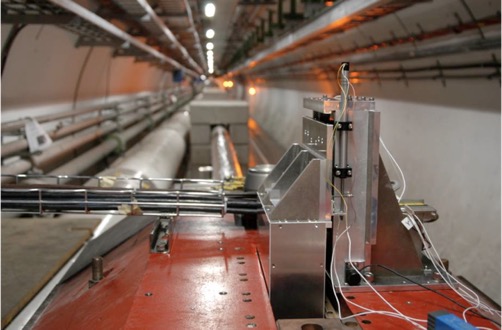
Unlike the four large experiments installed at the LHC accelerator at CERN in Geneva, the LHCf detector is positioned in a straight line 140 m from the ATLAS collision point. This position allows it to detect particles produced “forward", similar to those produced in cosmic ray cascades. Studying the number of secondary particles produced and their energy spectrum is crucial to understanding the interaction mechanism of primary cosmic rays with atmospheric nuclei. The models currently used to describe these processes have so far shown significant discrepancies between each other and with the data collected by the LHCf experiment.
The LHCf's contribution is crucial to understand the mysteries of very high-energy cosmic rays, providing useful information to determine which of the currently used models is most realistic and allowing for a better calibration of these models.
The LHCf Catania group contributed to the detector's design and data collection operations, with national responsibility. The detector concluded operations in 2025. Data analysis continues, with important results on the horizon, on the production of pions, eta mesons, kaons and lambda.





 Subscribe to RSS Feed