





The CMS experiment (Compact Muon Solenoid) is one of the four major experiments at the LHC (Large Hadron Collider) accelerator at CERN in Geneva. Its scientific mission, originally focused on the search for the Higgs boson (discovered in 2012), has diversified into a variety of precision studies and research of physical phenomena beyond the Standard Model.
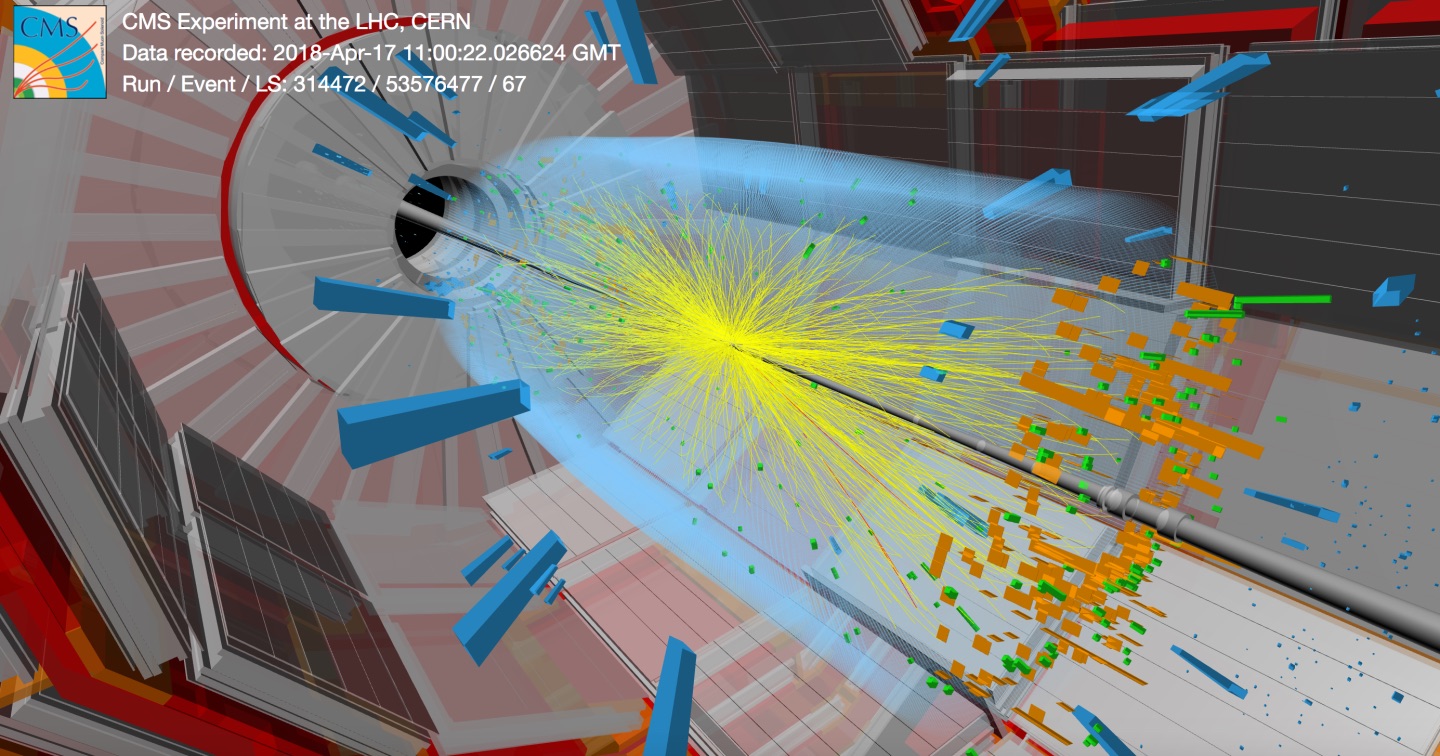
The CMS experiment's detector (15 m in diameter, 22 m long, and weighing over 14'000 tons) can study all the physical aspects of proton-proton collisions at a center-of-mass energy of about 14 TeV (1 TeV = 1000 billion electron volts = 1012 eV). The experimental setup contains sub-detectors capable of measuring the energy and momentum of photons, electrons, muons, and other particles created in collisions. The detector closest to the collision point is the silicon tracker, surrounded by the electromagnetic calorimeter, followed by the hadronic calorimeter. The tracker and calorimeters are located inside the superconducting solenoidal magnet, which generates a magnetic field of approximately 4 Tesla. The muon detection system is located outside the magnet.
The main objectives of the experiment are:
- study of particle physics at the TeV scale
- detailed study of the properties of the Higgs boson
- search for new physics beyond the Standard Model
The CMS collaboration involves more than 4000 people from 246 scientific institutes in 58 countries.
The CMS Catania group has contributed significantly to the construction of the current silicon microstrip tracker (installed in 2009) and the current silicon pixel tracker (installed in 2017, replacing the previous detector).
The CMS Catania group is currently involved in the construction of the new tracker, which will replace the current one in 2030. Specifically, qualification tests of the electronic circuits (front-end hybrids) used to read the signal produced by the particles in the tracker are being carried out in Catania.
The CMS Catania group, with coordination roles within the international collaboration, is also active in other activities as quality control of the data recorded by the detector, development of the construction database for the new tracker, data analysis search of supersymmetry.





 Subscribe to RSS Feed