





The Future Circular Collider (FCC) is the flagship project for the future of high-energy physics at CERN. As part of the update of the European Strategy for Particle Physics, the FCC-ee electron-positron collider was recommended as the best option for the next accelerator at CERN.
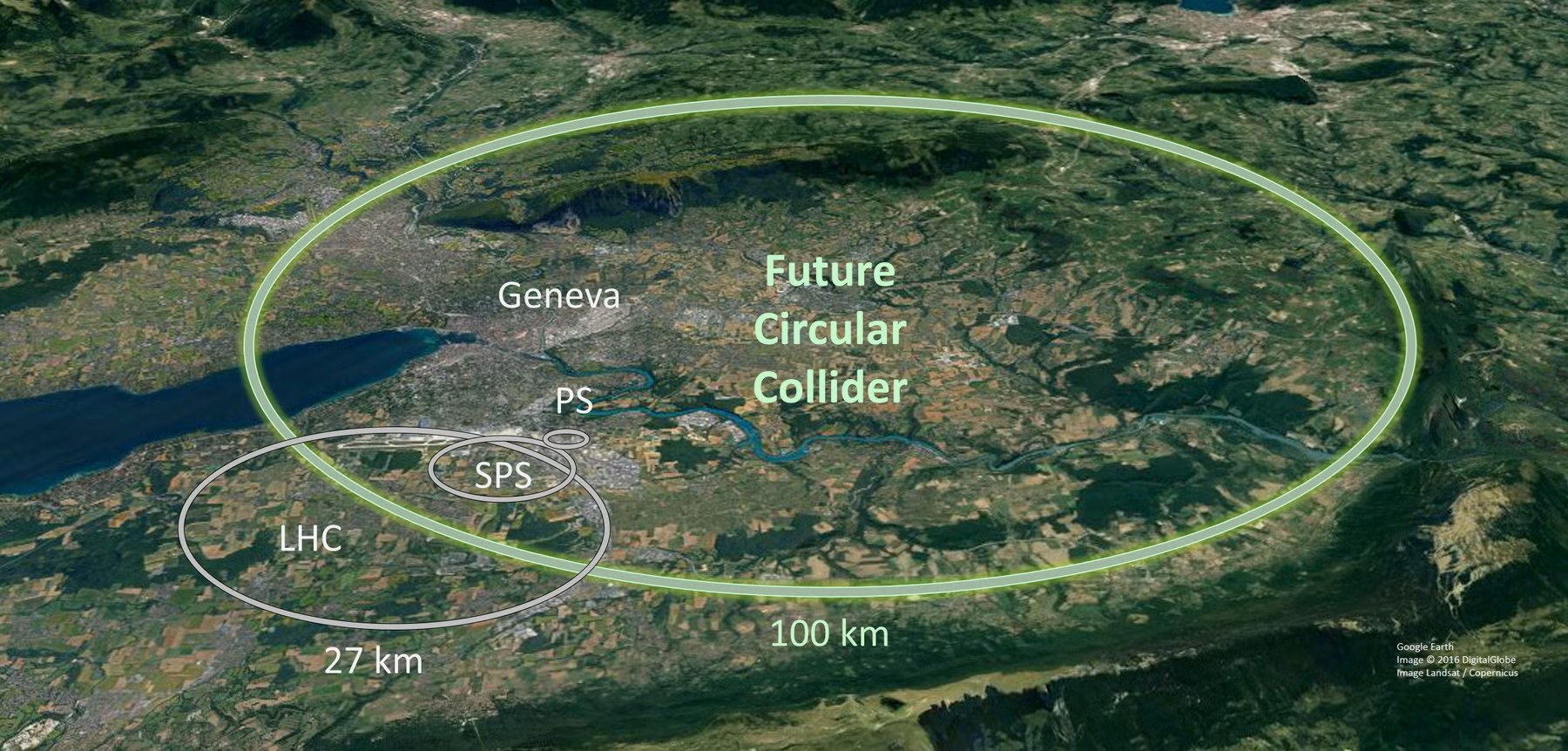
FCC-ee would be a unique scientific platform for addressing some of the major open questions in particle physics, particularly the precision study of the Higgs boson and its properties, the verification of the Standard Model, and the search for new physics.
The project is based on a circular collider with a circumference of approximately 90 km, capable of operating at center-of-mass energies between 90 and 365 GeV, configuring itself as a Higgs boson factory. The feasibility study, completed in 2025, provides the technical and scientific basis for the next phases of the project. The final decision on construction is expected in 2028, with a possible start of construction in 2030 and the start of collisions in the second half of the 2040s.
In parallel with accelerator development, the design of innovative detectors for experiments at future accelerators such as FCC-ee is underway. This includes IDEA, a detector optimized for precision measurements, which combines an advanced tracker, a powerful magnetic system, and a high-performance calorimeter.
The Catania group is contributing to the development of innovative dual-readout calorimeter technology, potentially used in future experiments such as IDEA. Activities include the design and construction of increasingly larger and finer-grained prototypes, performance evaluation via testbeams at CERN, qualification of silicon photomultipliers (SiPM), and assembly and testing of readout electronics. These development activities are essential to ensure adequate technological solutions for detectors of future experiments.





 Subscribe to RSS Feed