





MIRO - MInibeam RadiOtherapy
(2024-2026)
National Coordinators: Questo indirizzo email è protetto dagli spambots. È necessario abilitare JavaScript per vederlo.& Dr. Fabio Di Martino
Local Coordinator: Dr. Francesco Romano
The MInibeam RadiOtherapy (MIRO) project is a national project financed by the CSN5 of the INFN for 2024-2026.
The project investigates an innovative radiotherapy technique based on the spatial fractionation of the dose (SFRT) allowing to enhance the outcome of cancer treatment with radiations. According to many findings in the literature [1-3] , treating the tumor with a non-uniform spatial dose allows to obtain decreased toxicities induced to the healthy tissues, while preserving the same or also improving tumor damage as respect to conventional radiotherapy which uses uniform homogeneous fields.
In particular, minibeam radiotherapy which is one of the SFRT modalities also including GRID (cm fields) and microbeams (um fields), consists of makes use of sub-millimetric parallel beams (0.5-1 mm) spaced in 1-3 mm. This technique has recently gained interest being an achievable good compromise between feasibility of the GRID and efficacy of the MRT approach and have the potentialities to become suitable for clinical environments
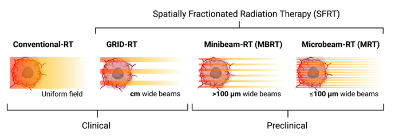
Figure 1: Pictorial comparison between conventional, GRID, Minibeam and Microbeam Radiotherapy, with the beam size for each of the mentioned irradiation modalities [1].
Prezado and Fois [4] in the last decade extensively explored the mini beam approach with protons in the so called pioneering pMBRT, which exhibits relevant prompt vascular repair in normal tissues and a superior tumor control with improved long-term survivals in gliosarcoma bearing rats [5,6].
However, the quantitative dependencies of the minibeam effect on spatial physical parameters are not fully understood, including the peculiar not uniform dose distribution. From the physical point of view, several dosimetric parameters have to be considered and accurately measured to characterized the radiation field: the dose at the peak and at the valley, the peak to valley dose ratio (PVDR) , the minibeam sizes (FWHM and center-to-center distance) and the average dose and dose rate [7,8].
In the perspective of the clinical translation of minibeam radiotherapy, the main aim of the INFN MIRO (MInibeam RadiOtherapy) project is in fact to systematically investigate in-vitro and in-vivo the variations of the biological effect as a function of the minibeam parameters which is of crucial importance for achieving a deeper understanding of the sparing effect in the healthy tissues.
The project involves six INFN divisions (Catania, Pisa, Torino, Trento, Roma, LNS) and have a strong multidisciplinary approach with expertise from beam delivery, dosimetry, radiobiology and computing to address the different faced challenges.
3 different facilities are available in the project, namely: the Centro Pisano for Flash Radiotherapy (CPFR) with 7 and 9 MeV electron minibeam accelerated at the conventional dose rate and at ultra-high dose rate (UHDR) [9], the research Linac installed at the Turin INFN division with 10-18 MeV electron minibeams and the Trento Protontherapy Centre with 70-180 MeV proton minibeams.
One of the main aims of the project is also to investigate the combination and possible synergy of both FLASH and minibeam radiobiological effect by using both UHDR and particle minibeams. This combination is achieved at the CPFR where the 7 and 9 MeV UHDR electron minibeams are produced with the possibility to vary all the beam parameters in a systematic way.
Activities at the INFN Catania division
The INFN Catania division is coordinating the whole project at the national level (with the PI) and the WP2 dedicated to the development of innovative detectors for reference dosimetry with particle minibeams, enabling the real-time measurement of the dose distributions at high spatial resolution (< 100 um). In particular, the need of accurately measuring all the different dosimetric parameters also in UHDR conditions is addressed by developing detectors based on Silicon Carbide (SiC), already proved to be suitable for FLASH radiotherapy dosimetry by our research group [10-12].
Different size SiC detectors, from 50x50 um up to 1 cm2, using arrays and matrix configurations are being currently developed and experimentally tested for the measurement of the transversal dose distributions and of the average dose respectively.
Monte Carlo Geant4 simulations of the particle (electron and proton) minibeams production through the use of passive collimators are also carried out to predict the physical parameters in the different conditions available in the project (facilities).
Our group is studying through Geant4 simulations the variation of the energy deposited spectra, i.e. the microdosimetric spectra, along the minibeam pattern (with different parameters) in the case of proton minibeams. Microdosimetry is a measure of the beam quality which, in the case of minibeam distribution, is certainly changing between the peaks and the valleys and can be directly correlated to biological outcomes.
References
[1] Mohiuddin M et al. (1999) High-dose spatially-fractionated radiation (GRID): a new paradigm in the management of advanced cancers. International Journal of Radiation Oncology Biology Physics 45, 721–727.
[2] Slatkin DN et al. (1992) Microbeam radiation therapy. Medical Physics 19, 1395–1400.
[3] Y. Prezado et al., Spatially fractionated radiation therapy: a critical review on current
status of clinical and preclinical studies and knowledge gaps, Phys. Med. Biol. 69 (2024) 10TR02
[4] Fernandez-Palomo, C.; Chang, S.; Prezado, Y. Should Peak Dose Be Used to Prescribe Spatially Fractionated Radiation Therapy?—A Review of Preclinical Studies. Cancers 2022, 14, 3625.
[5] Prezado Y, Fois GR. Proton-minibeam radiation therapy: a proof of concept. Med Phys 2013;40:031712.
[6]Lamirault C et al. (2020) Spatially modulated proton minibeams results in the same increase of lifespan as a uniform target dose coverage in F98-glioma-bearing rats. Radiation Research 194, 715–723.
[7] Prezado Y et al. (2018) Proton minibeam radiation therapy widens the therapeutic index for high-grade gliomas. Scientific Reports 8, 16479.
[8] Prezado Y et al. (2019) Tumor control in RG2 glioma-bearing rats: a comparison between proton minibeam therapy and standard proton therapy. International Journal of Radiation Oncology Biology Physics 104, 266– 271.
[9] Realization and dosimetric characterization of a mini-beam/ flash electron beam Pensavalle et al., Frontiers in Physics
[10] F. Romano et al. First Characterization of Novel Silicon Carbide Detectors with Ultra-High Dose Rate Electron Beams for FLASH Radiotherapy. Appl. Sci. 2023, 13, 2986.
[11] Milluzzo G et al 2024 Comprehensive dosimetric characterization of novel silicon carbide detectors with UHDR electron beams for FLASH radiotherapy Med. Phys. 51 6390–401
[12] G. Milluzzo et al., Dosimetric characterization of an encapsulated waterproof silicon
carbide detector with UHDR electron and proton beams for FLASH radiotherapy, Phys. Med. Biol. 70 (2025) 205019
THESIS OPPORTUNITIES
Bachelor and master degree thesis are avalilable on this topic. The students will have the opportunity to work with the Researchers of the INFN Catania Division involved in this activity, working in a stimulating environment. They will be fully supported during their thesis project, actively participating to the experimental activities planned at national and international laboratories. The possibility to carry out part of the project abroad at Research groups collaborating with INFN Catania Division is also envisaged.
For further information, please contact Dr. Questo indirizzo email è protetto dagli spambots. È necessario abilitare JavaScript per vederlo. and Dr. Questo indirizzo email è protetto dagli spambots. È necessario abilitare JavaScript per vederlo..
Past master degree thesis
S. Ahmad, Geant4 Monte Carlo simulations for dose distributions computation in FLASH and minibeam radiotherapy, University of Catania (Master degree thesis, July 2024)
P. Stochino, Geant4 simulations of electron minibeams produced with a clinical linac, University of Cagliari (Master degree thesis, February 2025)
E. Corvaia, Microdosimetric Spectra Evaluation For Proton Minibeam Radiotherapy Through Geant4 Monte Carlo Simulations, University of Palermo (Master degree thesis, July 2025)


 Sottoscrivi il Feed RSS